Gear: Battle of the GPS Apps

Like many runners, I have used GPS tools for mapping my runs to see how far and how fast I have gone. This has been an advantage for me when I have wanted to run a specific distance within a set time.

I started with a Nike+ watch that used GPS to track my routes and times. The watch would plug into my computer and save the information on the Nike+ Web site. I used that watch to track a particular distance — about a mile and a half out, so that I could do 5K runs by going out and back. When I did that, I got this map.
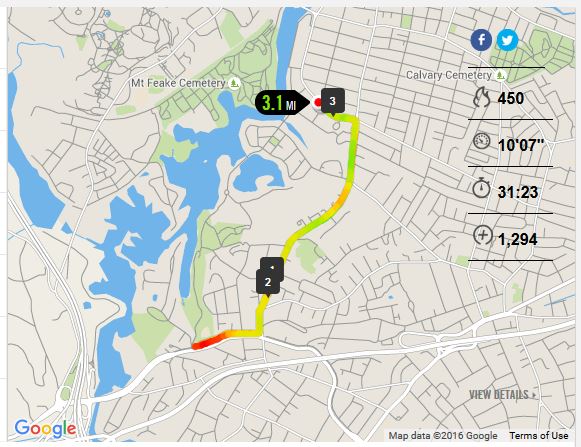
NikePlus Lyons Park Run

Note the distance is 3.1 miles. The problem is that my watch broke. More particularly, the connections inside the band failed. So, I sent it back to Nike, and since they had discontinued the watch, they very nicely gave me a voucher to replace it with another watch. (I welcome any suggestions on what would be a good replacement.)

In the meantime, I downloaded the RunKeeper app. at the suggestion of a friend of mine. I went out and ran the same route again. I wanted a 5K easy run after a bit of layoff thanks to a head cold.

This is what I got when I looked at their map.

RunKeeper Lyons Park Run

This says I ran four miles! So, which one is correct?

First, I know that the sharp eyed among you will point out that there are more than two extra minutes on the Runkeeper time. I am not fast enough that I added an extra mile on in less than three minutes. Second, it also appears that my pace time is much faster, but again not so much faster as to make the difference. Most importantly, though, I covered the same ground, from the same start point to the same end point. I have landmarks at each end to measure it. I went to the same places.

I will need to clock the route on a car odometer next and see what happens. One way or another, though, something is off.

The main value of these tools for me is in laying out training routes. As I try to get faster and figure out better ways to run a 5K, it is not just about adding distance. Have a good sense of how fast I cover a particular distance is important to my goals, so finding something accurate is important.

Have you used one of these tools? What has been effective and accurate? Let me know. I will post the results of the odometer test soon.

In the meantime, here is a nice, succinct piece on how to train with a GPS device by pro athlete Lauren Fleshman.

Let me know if you use one, and how accurate you find it to be.

Posted in Gear | Tagged , , , , , | Leave a comment

Digressions – What Do I Do With All These Shirts?

One of the perks of running races are the free tee shirts, but if you do enough of them, the shirts can pile up pretty fast. Here is a picture of my pile of race shirts.

Race shirts pile.

Running Shirts from Various 5-Ks (2002-2016)

There are 35 of them there from races I have run from 2002 through 2016. As you can see the pile is over a foot high. These are only the ones I have saved, a few have been tossed over the years. They take up even more space when folded and stacked neatly.

The shirts include plain cotton ones, tech shirts, long-sleeved shirts, and short-sleeved shirts. They have been good running shirts, but I have come to the point where I have too many and will need to decide which to keep and which need to go.

What do you do with these shirts? I guess some can be donated, but it seems a little weird to give race shirts. Do people in need really need a tech shirt that has the name of some random race on it?

Some of the races I have done offer alternative giveaways. Sometimes they come with a shirt and sometimes not. Here are three samples of other types of swag.

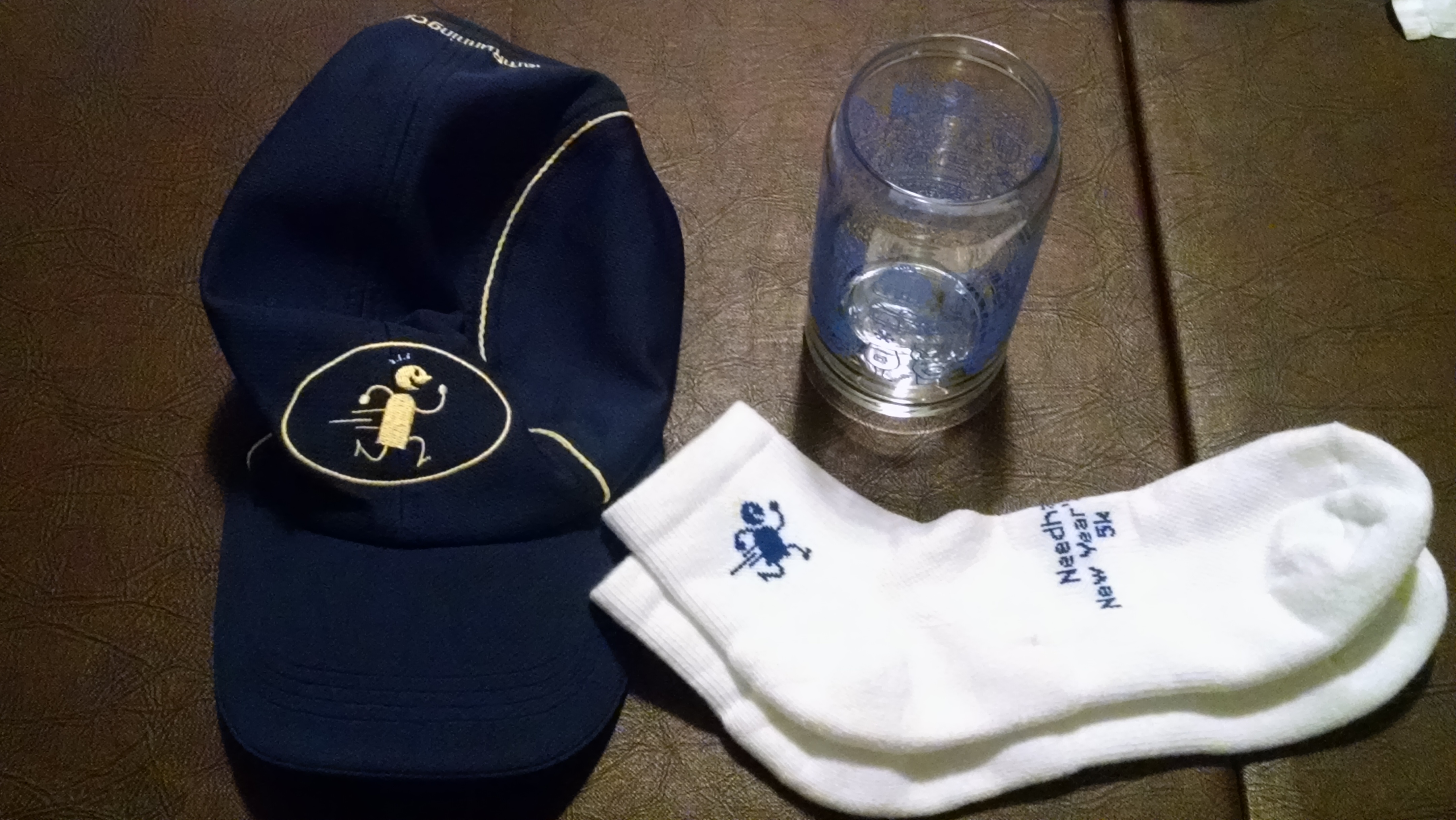
Cap, socks, and beer glass.

A cap, socks, and a, um, water-glass.

Two of these — the cap and the socks — are from the Needham Running Club. They deserve credit for thinking beyond the shirt. They also handed out running beanies for one of the New Year’s Day races. The glass came from the Cambridge 5K series. If you are involved in organizing a race, think about alternatives to tee shirts. I am sure that I am not the only runner with a pile of shirts this high.


Posted in Digressions, Races | Tagged , , , , | Leave a comment

Cross Training – Fitness Tests Show a Need for Improvement

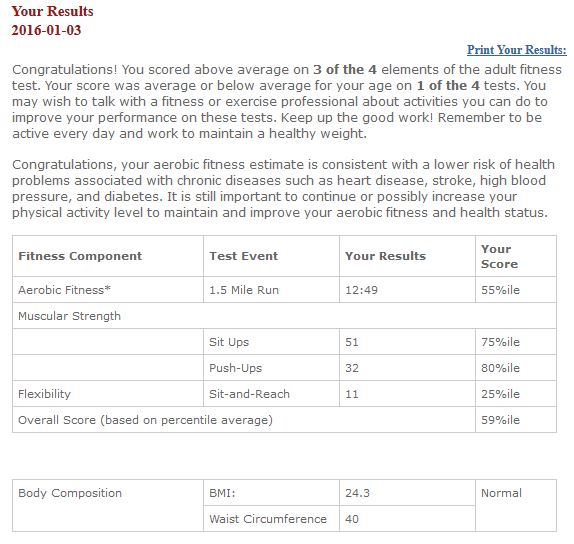
As part of getting into the new year, I thought it would be a good idea to do another Presidential Fitness test to see how I am measuring up. As with the New Year’s Day 5K, the results show that I have plenty of work to do.

01032016 Fitness Test

My run time needs work, and so do my push-ups and flexibility. My plan is to repeat the test each month and see how I progress. (I also add pull-ups, though that is not part of the test. I did one, which is terrible.)

The next steps are a combination of running and strength training — mostly in the morning, which means earlier bedtimes. The other aspect to all of this is diet. You can’t out-train a bad diet, as someone once told me. So there will plenty of work on eating as well.

I’ll share my training and results, but if you have any good ideas for me, please share.

Posted in Cross Training, Uncategorized | Tagged , , , , | Leave a comment

Races – Whiskey is no Way to Prep for a New Year’s Day 5K

It’s a new year, and like so many runners, I am back at it. While I did some running over the past few months, I have been bad about blogging — so there are two resolutions for 2016: run more and blog more.

On the last day of 2015, I spent the evening with friends playing a card game called “Anomia” and having a few grown-up beverages. There was some bubbly, and my variation on a cocktail created by New York bartender Dale DeGroff: The Satin Manhattan.

Here is the original recipe:

1 1/2 ounces Scotch

1/2 ounce vanilla liquor

2 dashes of bitters

Add all ingredients to a mixing glass filled with ice and stir. Strain into a chilled martini glass and garnish with a cherry.

I’ve always preferred this cocktail with bourbon, and that what was I used last night, along with black walnut bitters. I skipped the cherry.

My night ended around 4 a.m. this morning, but it wasn’t all drinking. Much of that time was spent playing card games, talking, and eating snacks.

This morning the Needham Running Club had its annual New Year’s Day 5K at 10 a.m. The weather was good, warm for New Year’s Day, and skies were clear. I made it to the sign up and start line, and then we were off.

Here are my results:

2016 NYD 5K Results

This is a little slow for me compared to times over the past year. So, I have concluded that whiskey and sleep deprivation are not good 5k training. In the interest of science, I have run this experiment at least twice and can tell you that the results are fully reproducible. In control races, I find I move much faster without whiskey the night before.

Now, I have a long way to go before I am competitive. The winner of my age group ran the race in 16:54. So, there is a fair amount of work to be done, but a new year is a good place to start a new program because it makes for a good measuring point. So, if anyone has suggestions, I am open to them.

Posted in Races | Tagged , , , , , | Leave a comment

Digressions – The Race is the Reward

I was running a penalty lap at the biathlon when it occurred to me: the race is the reward.

At this little event in New Hampshire there were no prizes and few bragging rights, just the potential for improvement.

When we do the biathlon we test ourselves when we’re running and we test ourselves when we are shooting. Where else would we ever get the opportunity to do that? Especially in combination! Even the penalty laps were fun after that.

Biathlon Range

Posted in Digressions | Tagged , , , , | Leave a comment

Races – Biathlon: Run, Shoot, Run Some More

Summer biathlons are one of the more unusual races in which I take part. Like the winter Olympic sport, the sport combines two disciplines – running and shooting.

The running is five laps of 800 meters. You run the first lap, then come to the range and shoot. You shoot four times and then there is a finishing lap. So, if you shoot perfectly, you run 4,000 meters.

The shooting is all done with .22 caliber, bolt-action rifles. In each shooting round, you have five shots to hit five knock down targets. The targets will flip from black to white when they are hit. For every shot you miss, you either have time added onto your total or you need to run a 100-meter penalty loop.

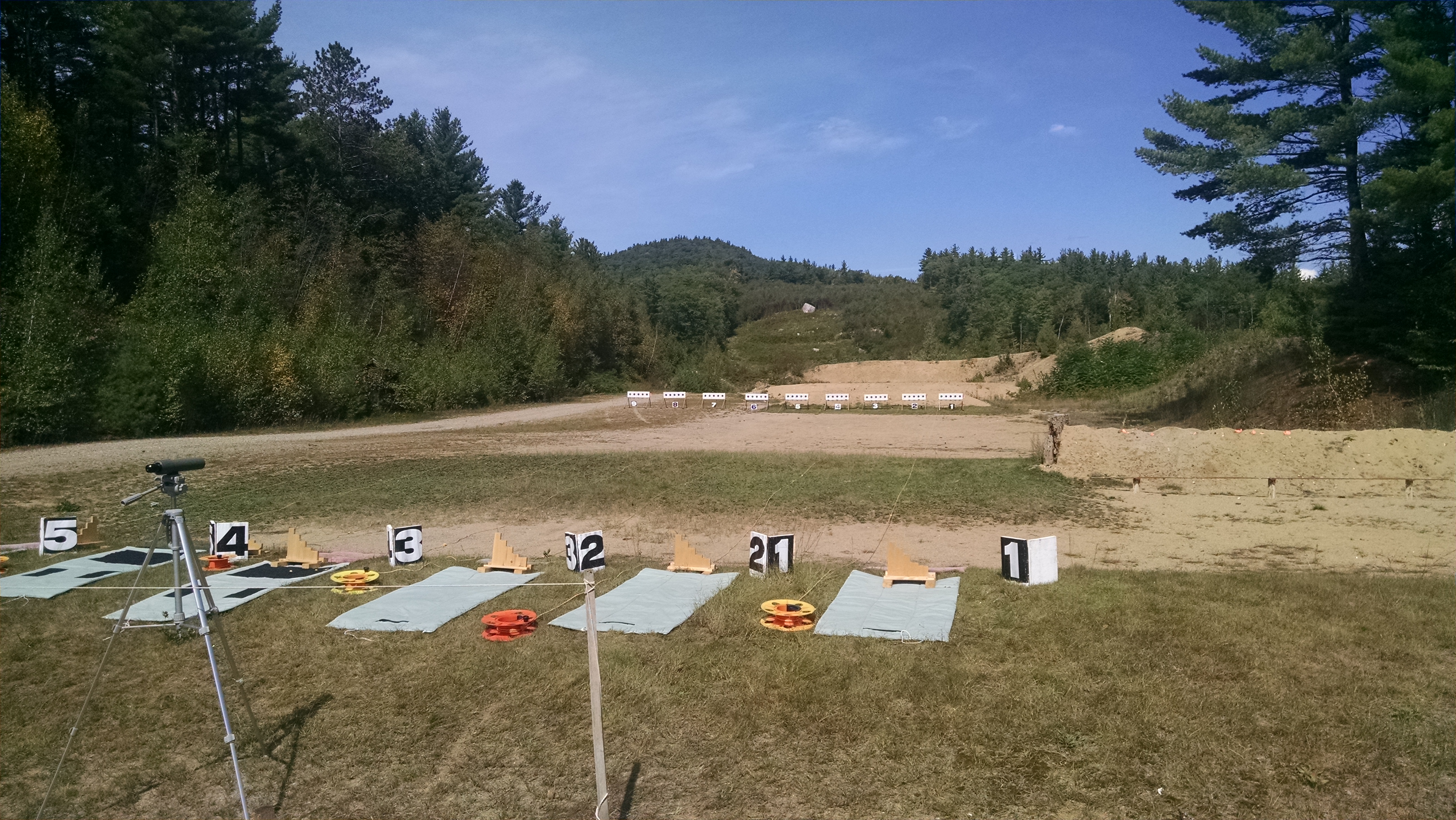
Pemi Biathlon Range

Here is the range, ready for the race.

If you miss every target, you add on an extra 20 laps, or 2,000 meters. So to be competitive, you need to both run well and shoot well, but these two skills are in opposition. Running relies on fast motion while good shooting relies on stillness and minimum motion. Economy of motion is important in both, but with biathlon you need to go from locomotion to no motion as best as possible.

Biathlon Targets

This is a closer view of the biathlon targets. The paper targets on the top are used for sighting in rifles before the race. They are taken down before the start of the race. The bottom shows what it would look like if you hit all the metal targets.

That challenge is the fun of the sport. Each race is a test of being able to go fast and slow, of large scale and small scale precision, and of mental toughness for big and small things.

In running you need the big muscle coordination. In shooting, the big muscle coordination generally ends once you get into the firing position. In most biathlons, you shoot two rounds prone and two rounds standing, which is also called offhand.

I should say something about the targets. They are all of nothing, as I mentioned above. Either you hit, and they flip from black to white – no penalty lap! – or you miss and run more. The targets are placed 50 meters (164 feet) out from the firing line. The targets when you shoot prone are smaller because you have the ground to steady yourself.

In the prone position, the targets are 45 millimeters, or about 1.8 inches. In other words, about the size of a silver dollar or the inner ring on a CD. The offhand, or standing targets are 115 millimeters or about 4.5 inches in diameter. These are about the size of a CD. At a 164 feet, those targets look awfully small.

Prone Biathlon Target

This is the target you need to hit from 50 meters (164 feet) when shooting prone.

About the rifles – there are no scopes or optics on any kind. You can have special target sights, but nothing that magnifies the picture. The rifles can have bolt-action or straight pull, but they are one shot at a time. This is good, because it makes you slow down and think about your shots.

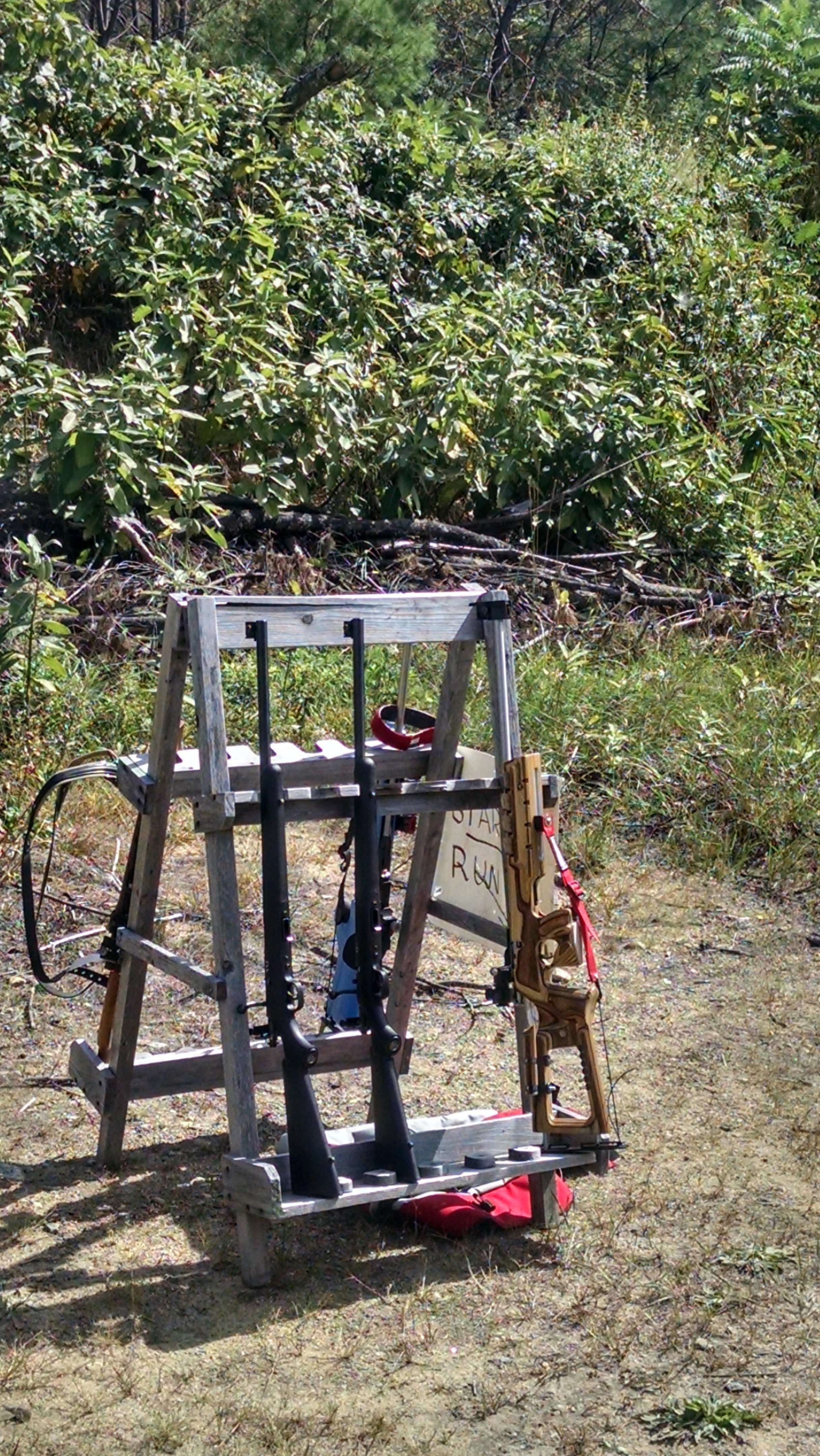
Biathlong Rifle Rack

The rifle to the far right is a fancy biathlon rifle, but the races can be done with regular .22 bolt-action varmint rifles like mine on the far left.

You do not run with the rifles. They stay racked at the range. Typically, there is a run walk line where you come in from running the course, walk to the rack, pick up your rifle by the barrel, carry it to the firing line, get in position, then load, aim, and fire.

Even with the walk line, your heart is still pounding pretty good by the time you get to that line. Then it is the process of breathing, getting into position, and steadying yourself for each shot. It is a great time.

I first read about this in a Boy’s Life magazine when I was in the scouts. I thought it sounded like a great time. (The article can be found here: https://books.google.com/books?id=2GYEAAAAMBAJ&pg=PA34-IA4&dq=summer+biathlon&hl=en&sa=X&ved=0CB0Q6AEwAGoVChMI9o7Yz7KGyAIVQVc-Ch0ixAfR#v=onepage&q=summer%20biathlon&f=false.) Then I did my first one in Seattle in 2006, with the Washington Biathlon Association. (http://www.wabiathlon.org/) My more recent ones have been at the Pemigewasset Fish and Game Cliub. (http://pemi.org/biathlon.html).

Harvard Sportsmens Club (http://www.harvardsportsmensclub.com/) also occasionally hosts biathlons.

One of the great things about biathlons is twice I have been on the course with Olympians. I didn’t come close to their performance, but it was great to meet them.

If you are a runner who just likes to go fast and hard, then biathlon probably isn’t for you. But if you are a runner who likes a challenge and likes to mix it up, then definitely take a chance on summer biathlon when you get the opportunity. Most events are very welcoming of beginners.

Posted in Races, Uncategorized | Tagged , , , , | 1 Comment

Digressions – Heels + Hips = Frustration

This morning they are running against Melanoma, and I sit here typing.


Grrr!


A week ago, I wrote about how after a race and a two-hour drive, my hips had tightened up to a degree I didn’t think was possible. I have taken the past week off of running, done some stretching, and a little light working out. Yesterday, I headed over to the YMCA and spent five minutes on the treadmill as a warmup to a weightlifting work out. That all went most okay. I was little tight, but it wasn’t awful.

So, my plan was to wake up this morning and see how I felt. If I was good to go, I would run the Melanoma 5K Run/Walk for Hope, which is part of the Race Around Waltham Series. I set the alarm, went to bed reasonably early, and woke up this morning. I felt mostly good, but my heels were hurting enough that I decided to skip the race.

For about the past month, I have had heel pain that would go away when I warmed up and stretched a little bit. It was worst in the morning right after I woke up. I have to believe that the hips and heels are related.

So, I skipped my second race this season this morning. I know that the medicine for this is movement, but I don’t think it is race movement. Walking and stretching and short jogs seem to be the road to recovery.

How do you handle forced layoffs? Any suggestions? I have about two weeks to get back to normal before the next race opportunity.

Posted in Digressions, Races | Tagged , , , , , , | Leave a comment

Races – Knowing My Limits and Skipping a Race

This past weekend, I was signed up to do a summer biathlon on Saturday and a trail run on Sunday.

Saturday morning, I got up early and drove about two hours to the Pemigewasset Fish and Game Club to run the summer biathlon. I will explain this more in a later post, but the short story is that it is the summer version of the Olympic biathlon, which is skiing and shooting. In the summer, it is running and shooting.

I did the race and drove another two hours home. At one point, I bent over and my whole lower back seized up. I have some elaborate thoughts around how this happened, but suffice it to say that I have not stretched enough after my training runs.

I was signed up for the three-mile race at the Middlesex Fells Trail Running Festival for the next day. I decided that I would set the alarm and see how I felt that morning.

When I woke up, I got out of bed with pain in my heels and my lower back/hips so tight that it was hard to stand up straight. Once I straightened out, I could move okay, but I decided that a trail race was not in the cards for me.

This next week is going to be one of rest and stretching for me. Maybe a few gentle cross training exercises. But I figure it is better to rest now and let this be a minor annoyance than to push through and have it become a major problem.

Still, if anyone out there has had similar troubles — given the stiffness and pain in my heels, I think it is more than just a tweaked back — please tell me what you have experienced. In the meantime, I’ll be stretching, resting, and probably writing gear and digression posts.

Posted in Races | Tagged , , , , , , | Leave a comment

Eating and Drinking – Where I Attempt Food Science — Turkey Melange

One of my least used categories is “Food and Drink,” which, to be honest, I had planned to use mainly for talking about post-race beers. But I have a recipe for you that combines protein, carbohydrates, and the goodness of vegetables. I think the combination makes it good runner’s food.  I call it Turkey Melange for lack of a better term. It was something that mom used to make when I was a kid.

The recipe is as follow:

1lb Ground Turkey

1 Small Onion

1 Tablespoon Olive Oil

1 Bag of Mixed Frozen Vegetables

2 Cups Water

1 Cup Brown Rice

Dice the onion. Put the olive oil in a large pot, then brown the turkey and onion. One the meat is browned, add the frozen vegetables, the water, and the rice. Bring the water to a boil. Then reduce the heat and cook until the rice absorbs all the water. Then season it with salt, pepper, or whatever spice appeals to you. The good thing about this recipe is that it is a little bland, so it can be easily adapted.

Turkey, Rice, Vegetables

I used the food labels and did a little math. This recipe makes six servings of one cup each.

Based on that, I believe each serving has:

195 Calories

85 mg of Sodium

3% of the RDA of Calcium

3 Grams of Fiber

This of course, assumes an equal distribution of ingredients in each serving. Calories, sodium, calcium, and fiber are the things I tend to track when I think about nutrition.

Hope this works out to be a tasty addition to your runner’s meals.

Posted in Eating and Drinking | Tagged , , | Leave a comment

Cross Training – How to Train for Getting Around Other Runners

Anyone who does organized races knows the pain of being stuck behind the walker, the slow runner, and the person with the jogging stroller. The question is, how do you train to get around them?

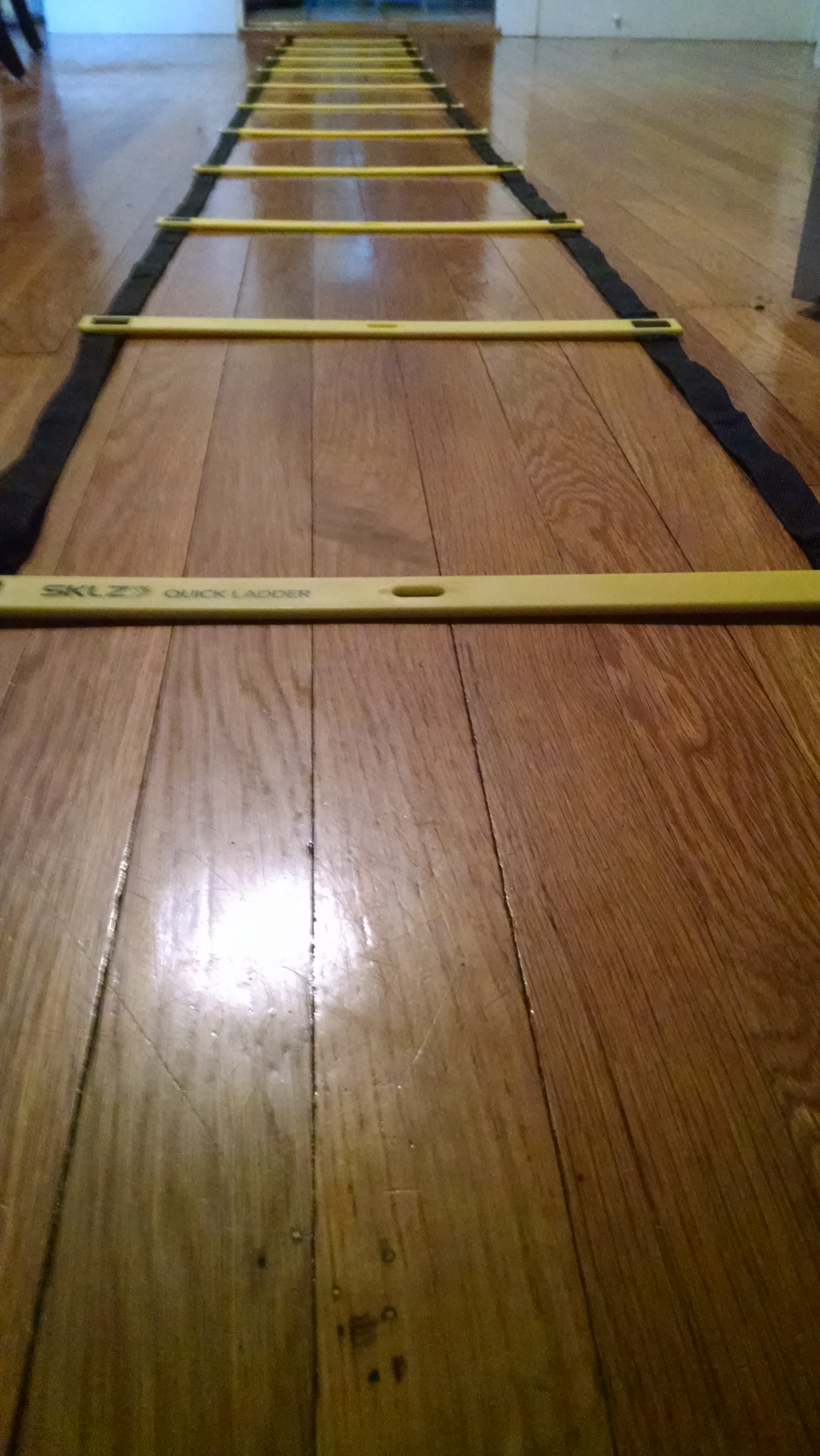
Not long ago I bought a SKLZ Quick Ladder. (Let me note that I am not sponsored by anyone. So all the gear I review has been purchased by me on my own volition. If that were to ever change, I would disclose it. Either way, I will work to keep my reviews as honest as possible.)

Agility Ladder

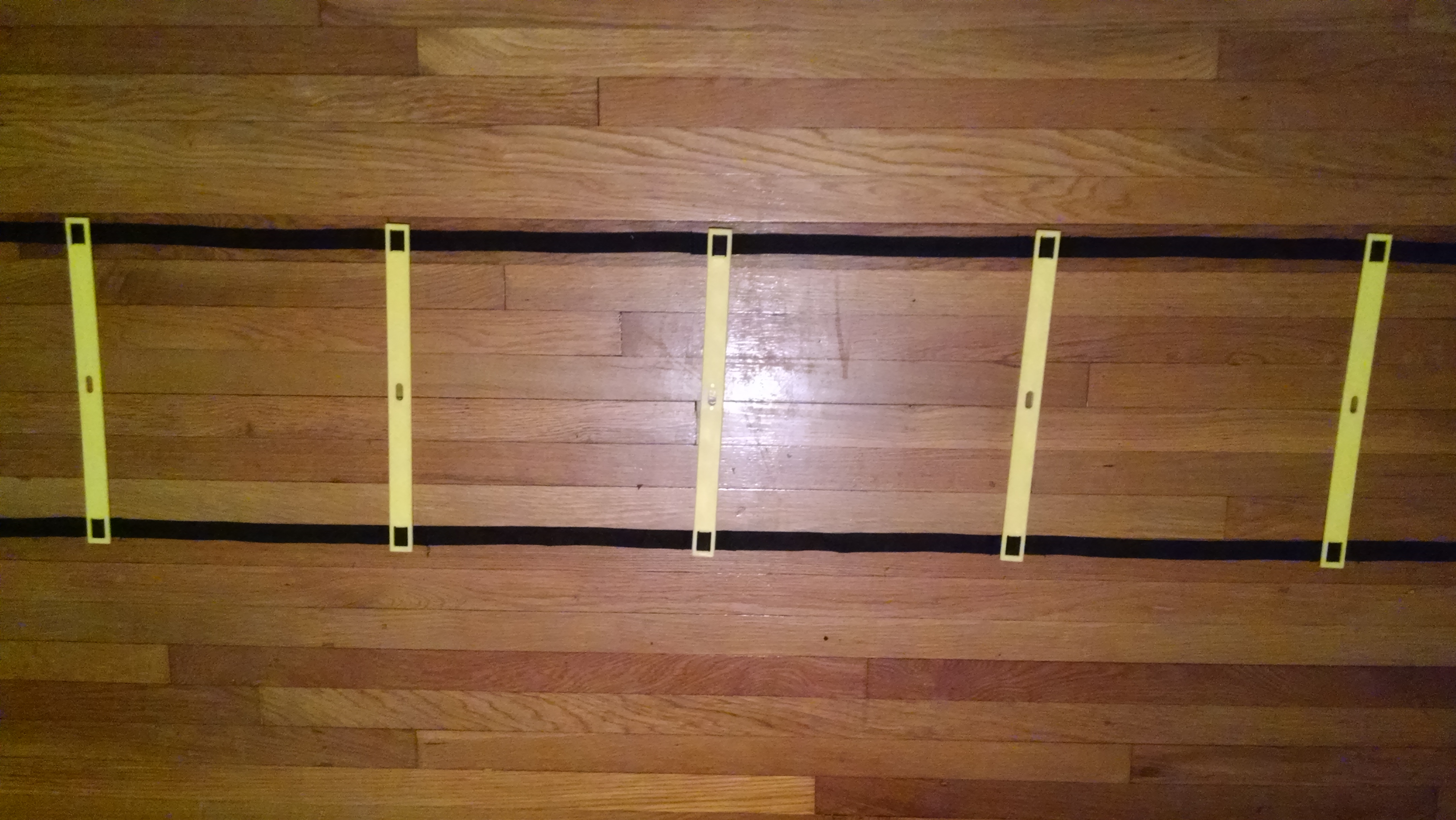
The ladder is flat rungs joined together by black nylon webbing. It is nothing particularly fancy, but it gives athletes a chance to work on the quickness of their feet. It came with a pamphlet of drills that include things like lateral shuffles, base rotations, and lateral in and out movements.

I had used agility ladders and other tools before as part of training in karate and other sports. When I started doing the drills in the pamphlet, I thought they were kind of interesting, but I didn’t know that they had any value to me as a runner.

Then, I was out running a path laid out in one of the maps from the “Running on the Road” post. In front of me was a couple out for their morning walk. As I stepped sideways to maneuver around them, I was able to pass them without breaking my stride. The movement felt exactly like a movement called “Lateral Shuffle with Hold” in the pamphlet. I felt more agile in that moment.

As an average runner, I tend to put myself towards the middle of the pack in races. This usually means that there are a lot of people around me until everyone settles into their pace. This takes about half a mile to a mile, depending on the course. The agility ladder drills give me some practice in dodging around people without needing other people. (So does running on local tracks, but that is another post.)

So, I think there is real value to agility ladder training for us middle runners that can help us improve.  But let me say that despite my buying a ladder, there is no requirement to buy something formal if it doesn’t fit the budget.

You can create agility ladders on a sidewalk or driveway with chalk, or use tape in your living room if that is better. You could also get creative with the tiles in a kitchen or hallway. I once had a hexagon in blue painters’ tape on the floor in my living room. Someone thought I was measuring for a table, but it was a variation on an agility ladder that I had found on a Web site.

So, if you find yourself frequently stuck behind other runners or on crowded paths, set up an agility ladder, google some drills, and start to experiment. You will likely find that the crowds aren’t as troublesome. (Though it will still be a blow to the ego when you are passed by the people who seemed slow or the ones pushing a jogging stroller.)

Agility Ladder Rungs

Posted in Cross Training, Gear | Tagged , , , , , , | 2 Comments